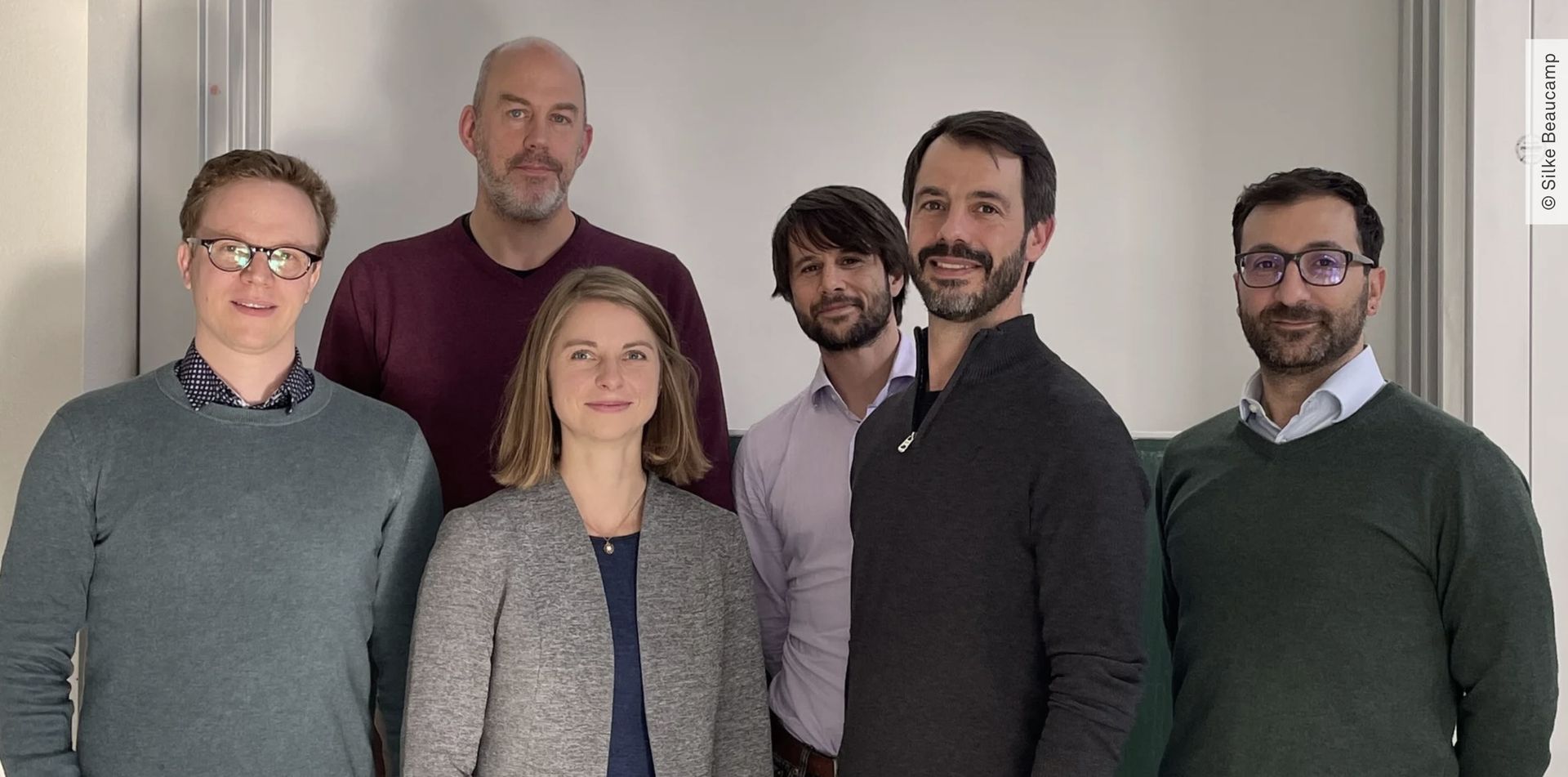
The deep-tech start-up Gaia Isotopic, emerging from the Department of Electrical Engineering and Information Technology at TU Dortmund University, has been awarded funding by the Federal Ministry for Economic Affairs and Energy (BMWE). With approximately €800,000 from the EXIST Research Transfer program, the team led by Natalie Schütz, Moritz Zimmer, and Dr. Álvaro Ortiz Pérez will receive 18 months of support to translate its results in photonic microsensor technology into practical applications. The goal is to develop a new method for real-time analysis of metabolic processes in cells, which is expected to be used in cancer research in the future.l
“For us, the EXIST funding is a major milestone: it gives us the opportunity to advance our technology into a finished product and research tool that will open up unprecedented possibilities for biochemical research,” says Natalie Schütz, co-founder of GaiaIsotopic. Together with Moritz Zimmer and Dr. Álvaro Ortiz Pérez, she is conducting research at the Professorship of Sensor Technology under Prof. Stefan Palzer on an analytical solution that will provide new insights into cellular metabolism. At the heart of the so-called Iso-Flux technology is a micro-integrated photonic sensor approach that enables dynamic monitoring and real-time investigation of cell behavior for the first time. The GaiaIsotopic team aims to bring about a paradigm shift: their innovative approach is designed to replace invasive methods and time-delayed measurements.
Potential for basic research
The new method is particularly promising for
studying the functioning of cancer cells. Only by precisely
understanding how tumor cells process nutrients can researchers develop
new therapies. “Our process makes it possible, for the first time, to
directly obtain data on nutrient metabolism in tumor cells – an enormous
potential for basic research as well as for the development of new
therapeutic approaches,” explains Moritz Zimmer. Thanks to the EXIST
funding, the team can carry out a proof of concept, demonstrating that
the idea works in principle. The next step will be to develop a
market-ready product. Initial automated test series will be conducted,
cell cultures analyzed, and the results prepared as usable data. By
early 2026, a first version of the method is expected to be completed,
which will then undergo testing, evaluation, and further development.
The Gaia Isotopic team is complemented by Dr.
Andrea Cantone, an expert in the commercialization of intellectual
property. The start-up also benefits from the expertise of Dr. Peter
Kreuzaler, a distinguished cancer researcher at the Cluster of
Excellence Cellular Stress Responses in Aging-associated Diseases (CECAD)
at the University of Cologne, who supports the development from a
user’s perspective. In addition, GaiaIsotopic maintains close ties with
the Department of Electrical Engineering and Information Technology at
TU Dortmund University, giving it access to a leading center for
microsystems technology. The team profits both from the academic support
of Prof. Stefan Palzer and from the cleanroom infrastructure of his
chair. It also makes use of the services offered by TU Dortmund
University’s Center for Entrepreneurship and Transfer (CET) and collaborates closely with the CET team.